| 4Most Innovations, LLC |
| 40 W 4th St |
| Minster, OH 45865 |
| PH.: 419.628.2812 |
| FX.: 419.628.3416 |

|
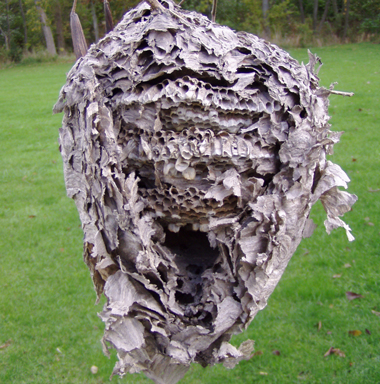
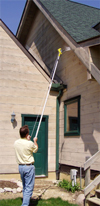
The Gotcha Sprayer Pro adaptor enables you to attach and trigger wasp and hornet spray from an extension pole, for killing wasps, paper wasps, yellow jackets, Carpenter Bees, and hornets nests.� The Gotcha Sprayer Pro will trigger virtually any aerosol can diameter, length, and nozzle style used for spraying and killing wasps, yellow jackets, and hornets nests.� It attaches to any extension pole with a standard American threaded tip.� It will attach to your existing extension pole (if it has a standard American threaded tip) or you can purchase an extension pole from our online store. Yellow Jackets (Vespula): There are over thirteen species of yellow jackets in the U.S. Yellow jackets cause the majority of the stings that people receive. This is because there are a high number of yellow jackets. They tend to nest around buildings and they are attracted to many sugar based foods that people eat, such as fruits, juices, soda, and candy. Yellow jackets can inflict multiple stings, and they will vigorously defend their nests. As with most yellow jackets, wasps, and hornet species, the colony is started by the queen. The yellow jacket queen lays the eggs that develop into female workers, males, and future queens. Some species build their nests in trees, shrubs, or even in underground burrows. Aerial yellow jackets, commonly referred to as bald faced hornets (Dolichovespula maculata), which aren�t actually hornets, have black and white markings on its thorax and abdomen. They build above ground nests that look like large, gray over-inflated footballs made out of wood fiber paper. The queen yellow jacket builds a small comb, similar to the paper wasp. As she starts to lay eggs, worker yellow jackets continue to build up cells and combs. As the nest grows several layers of combs are added. Each comb could have several hundred cells, and there could be many layers of combs each hanging one under the other. The yellow jackets, however, wrap the combs so they are completely enclosed in the gray wood fiber paper material. A large yellow jacket nest could support thousands of workers. They locate the nests in trees 10 to 15 feet high, shrubs, and under building overhangs. The bald faced hornet can be found everywhere in the U.S., except for the central and southern regions. They usually become active in the early spring and range into mid-summer. Bald faced hornets feed their larvae on flies and sometimes other species of yellow jackets. Bald faced hornets will aggressively defend their nests if they feel threatened. Their nests are difficult to find while the leaves are still on the trees. Another type of yellow jacket, with yellow and black markings, builds it�s nest similar to bald faced hornets i.e. small series of combs made up of cells surrounded by gray wood fiber paper, however, these nests are located in the ground. Some yellow jackets can build their nests in wall voids, dead hollow trees, and attics. In nature, these yellow jackets, wasps and hornets serve a beneficial purpose of controlling pest insects such as flies and caterpillars. It is when they build in backyards, park, golf courses, and picnic areas that they become a problem. When natural food sources become scarce, garbage cans and dumpsters become a popular place for workers to find sources of food, such as, soda cans, and candy wrappers etc. With larger colonies having thousands of workers, mixing with children and people with allergies can become a real problem. Common yellow jackets are found around the north, and northeastern parts of the U.S., as well as, in Canada. They can be found in higher elevations and have a tendency to build nests in evergreens. The eastern yellow jackets are found throughout the Midwest, as far south as Texas and as far North as the Dakotas. They are not as large as most yellow jackets, but do have very large colonies consisting upwards of 4,000 workers. Their nests are generally a darker tan color, instead of the typical gray coloring. The German yellow jacket builds its nest in the ground in Europe, however in the U.S., many of their nests have been discovered in structures such as wall voids and attics. They are found in the northeastern parts of the U.S. Yellow Jacket, Wasp and Hornet Control: Nests or nest entrances can be found by observing where the workers are flying to and from. Above ground nests will either be exposed combs made up of many cells that look like gray paper. Some nests may look like over-inflated gray paper footballs. Underground nests will have an entrance hole surrounded by a small wall of fine dirt. As with any yellow jacket, wasp, or hornet, the safest thing to do is to call a professional. If you are inclined to kill the wasps by yourself, the only way to keep your distance is by using the Gotcha Sprayer adaptor, wasp and hornet spray, and a long extension pole. We have extension poles available from 8ft to 18ft long. When combined with the 10ft to 15ft effective reach of the wasp and hornet spray, you can spray from approximately 33ft away. When using the Gotcha Sprayer Pro adaptor, you can both spray wasp and hornet spray, and can use our powder duster to kill underground nests as well. Spraying wasps, yellow jackets and hornets is much easier with the Gotcha Sprayer and Gotcha Sprayer Pro.� Spraying cans of aerosol wasp and hornet spray from the ground when trying to reach the peak of a roof or the eaves is a messy job, not to mention getting the over-spray on your house, in your eyes, and in your lungs.� Simply insert a can of wasp and hornet spray, secure by tightening the strap, attach to an extension pole, and spray.� Easily kill wasps and kill yellow jackets.� By positioning the wasp and hornet spray directly in front of the nest, there is less over-spray and is much safer than using a ladder.� With the Gotcha Sprayer Pro you can easily add a duster for applying insecticide dusts.� Sometimes wasp and hornet spray alone will not kill carpenter bees. Using the Gotcha Sprayer Pro with a powder duster, enables you to leave a residual dust in the carpenter bee nest, eventually killing the carpenter bees.� The Gotcha Sprayer Pro can be purchased alone or as a kit, enabling you to spray aerosols or powder dusters yet costing much less than the Bee Pole or the Dustick (dust stick).
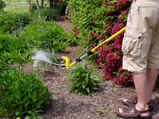
The combination of the Gotcha Sprayer Pro and our Powder Duster let's you apply the dust close to the vegetation, reducing waste and drift. |
 The stinging insects that people most commonly come in contact with are classified in the order of Hymenoptera. That includes: yellow jackets, hornets, and wasps. In general, yellow jackets, hornets, and wasps have a negative reputation around people, however when they are not intruding in our personal space, they can be helpful in certain ways: yellow jackets, hornets, and wasps feed their young largely on flies and caterpillars. yellow jackets, hornets, and wasps help keep these pests population in check. Unfortunately, the personality of these insects changes as the season progresses. Early on yellow jackets, wasps, and hornets will only defend their nests when they feel threatened. As the season progresses and food sources become less available, they become more aggressive. yellow jackets, hornets, and wasps are considered social insects and live in colonies. Within the colonies there is a distinct hierarchy between builders, gatherers, and reproducers. Some colonies of insects continue for many years, others such as yellow jackets, hornets, and wasps start over every year.
 Using the
|
|||||||||||||||||||
|