| 4Most Innovations, LLC |
| 40 W 4th St |
| Minster, OH 45865 |
| PH.: 419.628.2812 |
| FX.: 419.628.3416 |

|
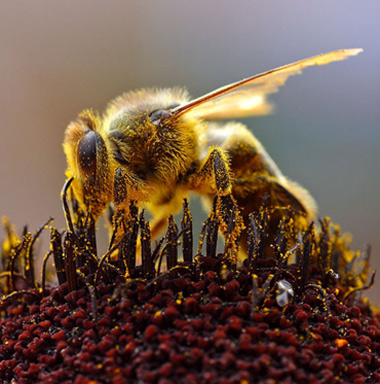
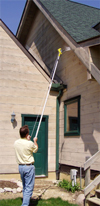
The Gotcha Sprayer Pro adaptor enables you to attach and trigger wasp and hornet spray from an extension pole, for killing wasps, paper wasps, yellow jackets, Carpenter Bees, and hornets nests.� The Gotcha Sprayer Pro will trigger virtually any aerosol can diameter, length, and nozzle style used for spraying and killing wasps, yellow jackets, and hornets nests.� It attaches to any extension pole with a standard American threaded tip.� It will attach to your existing extension pole (if it has a standard American threaded tip) or you can purchase an extension pole from our online store. Honey Bees (Apis Mellifera): The Honey bee is social insect that has the ability to communicate with other Honey bees, such information as, sources of pollen and where they may be located. Honey bees make combs that look like a series of wax cells. These wax cells are where Honey bees raise their young and store honey. Once the summer food supplies diminish, the bees will live on the honey for the winter. When a Honey bee colony has outgrown its existing space, they may look for a new location, such as, an old hollow tee or sometimes areas where people live. Older homes with voids in the walls or attic spaces can be an inviting space for bees. During this transitional period Honey bees have a tendency to swarm, until they can find a new location and start building again. Some colonies can have over 55,000 bees. If a Honey bee colony decides to build its next home inside the walls of a house, it can be quite a problem. The Honey bees could chew through the dry wall and end up in the house. The honey in the wax cells, larva carcasses, and dead bees can attract wasps, beetles, and moths. I order to fix the problem, the bee colony killed and removed. If the honey combs are left in the walls, they could melt over time and create additional problems, such as staining, mold, and attracting moths. The honey itself will attract other wasps and bees. The dead bees will attract carpet beetles. Killing the bees can be done similar to wasps and hornets using sprays or foams. In order for the comb to be removed, the wall will need to be cut away and replaced. This should only be done once the colony is dead and the nest can be removed. The access location should be sealed by replacing the wood or caulking the hole closed. This will prevent future colonies from building in the same location. Honey bee colonies have a definitive structure. The Queen is the largest of the bees and is responsible for the growth of the hive. Worker bees are actually undeveloped females, are the smallest bees. They are responsible for feeding the queen and the larvae. They also collect pollen, make the honey and build the wax combs. The male bees are referred to as Drone bees. Their task is to mate with the queen. The male bees do not have stingers. Like yellow jackets, wasps and hornets, worker honey bees do have the ability to sting, but only one time. Each has a stinger, which is actually a hollow shaft with barbs on the outside. The barbs on the honey bee stinger are much larger than on the wasps stinger. Once the stinger is in the victim, poison from the poison sack flows down the hollow shaft and into the victim. Because of the smaller barbs, yellow jackets, wasps, and hornets have the ability to remove the stinger and fly away. The honey bee, however, has to actually rip the stinger and poison sack from its body in order to fly away. Honey bees usually will die a short time after inflicting a sting. Spraying wasps, yellow jackets and hornets is much easier with the Gotcha Sprayer and Gotcha Sprayer Pro.� Spraying cans of aerosol wasp and hornet spray from the ground when trying to reach the peak of a roof or the eaves is a messy job, not to mention getting the over-spray on your house, in your eyes, and in your lungs.� Simply insert a can of wasp and hornet spray, secure by tightening the strap, attach to an extension pole, and spray.� Easily kill wasps and kill yellow jackets.� By positioning the wasp and hornet spray directly in front of the nest, there is less over-spray and is much safer than using a ladder.� With the Gotcha Sprayer Pro you can easily add a duster for applying insecticide dusts.� Sometimes wasp and hornet spray alone will not kill carpenter bees. Using the Gotcha Sprayer Pro with a powder duster, enables you to leave a residual dust in the carpenter bee nest, eventually killing the carpenter bees.� The Gotcha Sprayer Pro can be purchased alone or as a kit, enabling you to spray aerosols or powder dusters yet costing much less than the Bee Pole or the Dustick (dust stick).��
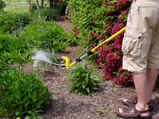
The combination of the Gotcha Sprayer Pro and our Powder Duster let's you apply the dust close to the vegetation, reducing waste and drift. |
 The stinging insects that people most commonly come in contact with are classified in the order of Hymenoptera. That includes: yellow jackets, hornets, and wasps. In general, yellow jackets, hornets, and wasps have a negative reputation around people, however when they are not intruding in our personal space, they can be helpful in certain ways: yellow jackets, hornets, and wasps feed their young largely on flies and caterpillars. yellow jackets, hornets, and wasps help keep these pests population in check. Unfortunately, the personality of these insects changes as the season progresses. Early on yellow jackets, wasps, and hornets will only defend their nests when they feel threatened. As the season progresses and food sources become less available, they become more aggressive. yellow jackets, hornets, and wasps are considered social insects and live in colonies. Within the colonies there is a distinct hierarchy between builders, gatherers, and reproducers. Some colonies of insects continue for many years, others such as yellow jackets, hornets, and wasps start over every year.
 Using the
|
|||||||||||||||||
|